
Journal
Reading Client Stories Before a First Order: What Fragrance Case Studies Prove
A fragrance case study is a marketing document, and that does not make it worthless. It shows which categories a manufacturer has actually shipped, which markets it has handled, and how it describes its own work. What it cannot show is whether the project ran on time, whether the buyer would sign again, or how the relationship behaved when something went wrong. Reading a case page well means separating those two things before you place a first order.
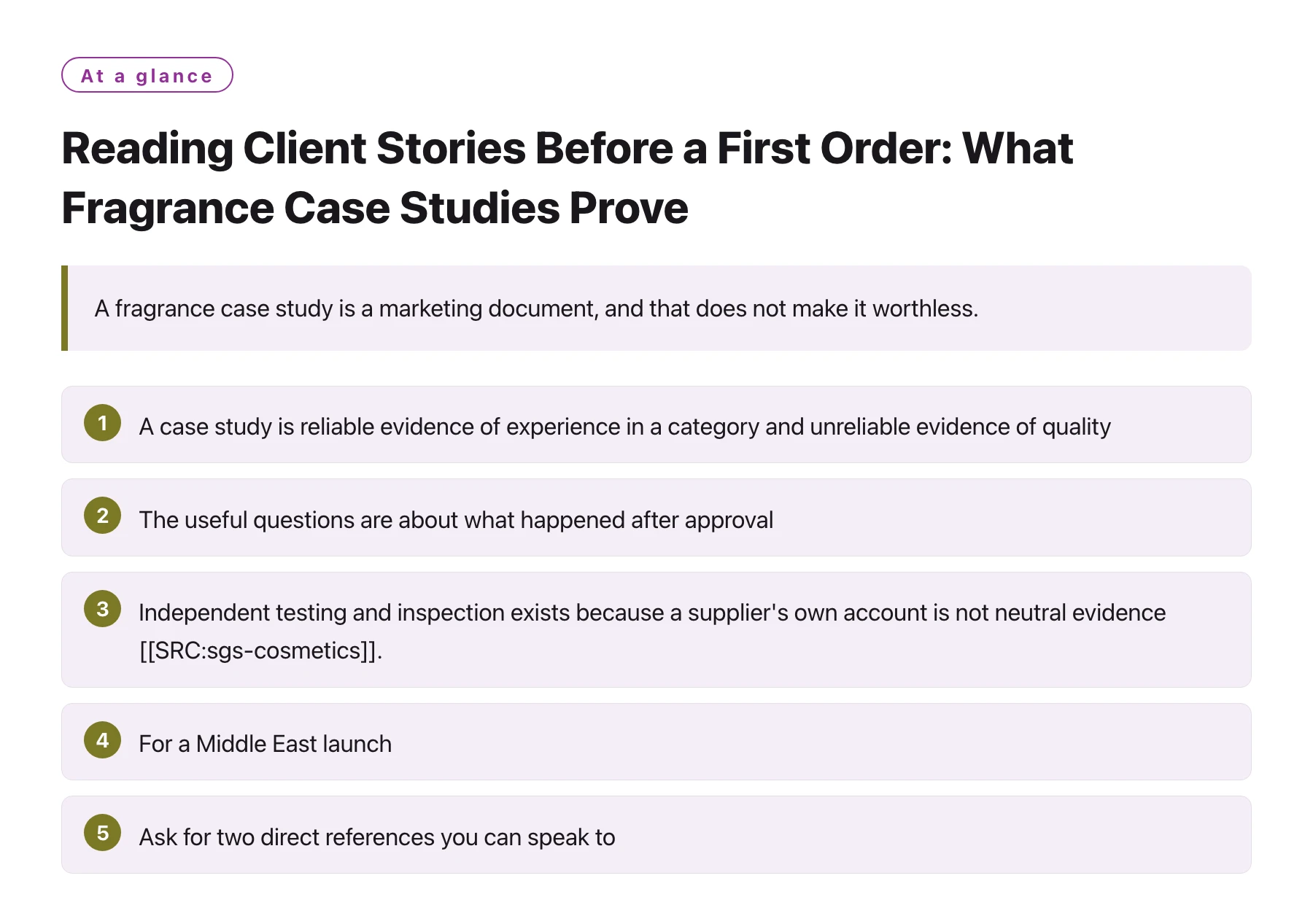
Key takeaways
- A case study is reliable evidence of experience in a category and unreliable evidence of quality, timing or service.
- The useful questions are about what happened after approval, not about the finished product in the photograph.
- Independent testing and inspection exists because a supplier's own account is not neutral evidence [1].
- For a Middle East launch, verify the specific regulatory and packaging experience rather than the number of stories on the page.
- Ask for two direct references you can speak to, and treat a refusal to provide them as information in itself.
Most manufacturers publish a page describing brands they have worked with. The page usually shows categories, sometimes regions, occasionally a brief narrative about a challenging project. Buyers preparing a first order tend to read these pages the way they read customer reviews, looking for reassurance, and then make a decision on that feeling.
Reassurance is not the same as evidence. A case page can be entirely truthful and still tell you nothing about whether your own project will run well, because the variables that decide your project, your brief, your timeline, your market requirements, are not the ones the page describes.
This walkthrough sets out how to use a case page as a starting point for verification rather than a substitute for it, from the perspective of a founder preparing a first fragrance order for a Middle East launch.
What a case study is actually evidence of
A published case study is good evidence of three things: that a manufacturer has worked in a category, that it has produced packaging of a given type, and that it is willing to describe its process in public. Those are not trivial. A house that has filled refillable formats, decorated heavy glass and shipped to Gulf retail has already solved problems that a first-time buyer has not yet met.
The document is weak evidence of everything else. Delivery reliability, communication under pressure, how a batch deviation is handled, whether a second order was placed, none of that appears on a case page, because the page is written to attract enquiries rather than to inform a purchasing decision.
The practical response is not cynicism. It is to treat the case page as a map of experience that tells you which questions are worth asking, and then to ask them in a form that produces checkable answers.
Why the photograph is the least useful part
Buyers are drawn to the finished bottle, and the finished bottle is the part of the record that proves the least. A polished photograph confirms that at least one unit was produced at a standard worth photographing. It does not confirm that the run was on time, that the whole batch matched the approved reference, or that the buyer stayed with the supplier.
The written elements around the photograph are more informative. How a manufacturer describes the brief it received, the constraint that made the project difficult and the decision it made is a much better predictor of how it will behave on your own project.
A first-order walkthrough: working through a case page in ninety minutes
Set aside the photographs and read the page as a sequence of claims. For each one, note whether it describes an input, which the manufacturer controls, or an outcome, which it usually does not. Then map the claims onto your own scope: category, format, decoration, volume and destination market.
Take a concrete example. A founder preparing a first order for a Middle East launch needs a house that has handled premium presentation, warm-climate wear expectations and documentation for the destination market. A case page mentioning gift sets and travel formats is directly relevant. A page describing a large body care programme is less relevant even if it is more impressive, because the packaging and fill technology are different.
The comparison is faster than it sounds. Ninety minutes with three case pages, a notebook and your own scope page will usually produce a shortlist of four or five specific questions, which is more than most buyers bring to a first call.
Map the case to your own scope, not to the industry
Industry experience is not the same as applicable experience. A manufacturer can be genuinely experienced and still be a poor fit for your format, your volume or your market. The mapping exercise protects you from a common failure mode in which a strong portfolio creates confidence that is never tested against the actual brief.
Written client stories are useful here precisely because they let you compare like with like. Xuelei's client stories on a manufacturer's site can be read alongside your own scope page in the same session, and any category that appears in your brief but never in the portfolio is a question rather than a disqualification.
Ask what happened after approval
The most revealing question about any past project is what happened between sample approval and delivery. Was there a reformulation, a packaging substitution, a delay, a deviation on the fill line? How was it communicated, and what did the buyer do about it?
A manufacturer that answers this question with a real example, including the part that went badly, is giving you more useful information than one that describes only successful outcomes. Referencing an incident is a sign of an organisation that has a process for incidents, which is what you want on your own order.
What no case study can prove
No portfolio can prove that your order will be handled by the team described in it. Sales, development and production are different functions, and the people who present a capability are rarely the people who run the filling line. This is the single most common gap between expectation and experience on a first order.
No portfolio can prove compliance either. Whether a product can be placed on a given market depends on the finished formula, the labelling and the notification duties for that market, not on other projects the manufacturer has completed. Where third-party verification matters, it is worth knowing that independent testing and inspection bodies exist for exactly this reason [1], and that a manufacturer familiar with third-party review will not be surprised when a brand asks for it.
Finally, no portfolio can prove commercial fit. A manufacturer set up for large runs may be excellent and still wrong for a first order of a few thousand units. Scale mismatch is a scope problem, and it is settled by asking about minimum order quantities and tooling in writing rather than by counting case studies.
Use neutral sources where the claim is a legal one
When a question moves from capability to regulation, supplier documents stop being the right reference. Industry associations and public authorities publish the material that actually governs a launch, and both are more neutral starting points than a brochure. For European launches, the European Commission's cosmetics pages are a sensible first stop [2], and Cosmetics Europe publishes industry-level guidance and position papers that sit alongside them [3].
Reading one neutral document before the first call changes the conversation. Instead of asking whether the manufacturer can handle compliance, you can ask which specific documents it will supply and which remain the brand's responsibility.
Two references beat twenty stories
A portfolio shows range; references show behaviour. Ask for two contacts from projects comparable to yours in format, volume and market, and ask them the operational questions: how were changes handled, how were delays communicated, would you run the project the same way again.
Some manufacturers cannot share client names because of confidentiality agreements, which is legitimate. In that case ask whether a reference call can be arranged through the manufacturer without disclosing the brand, or whether the partner can describe the project's structure in detail. A blanket refusal, with no alternative, is itself a data point.
A useful habit for a first order is to build your own case record as the project runs: the scope page, the approved reference, the batch record, the deviation log and the final delivery note. It costs almost nothing to maintain and it turns your next supplier conversation into a two-way one. Brands that can describe their own last project precisely are treated differently by manufacturers, because they are visibly able to judge what they are being told.
Turning verification into a short list of questions
The output of this exercise is not a verdict on a manufacturer. It is a short list of questions, each traceable to something in your own brief: how will the fill weight be verified on this format, which documents arrive with the shipment, who signs off a deviation, what happens if the second batch drifts from the retained reference.
Those questions do more work than any portfolio review, because they cannot be answered by a well-designed case page. Any partner that has run comparable projects will answer them in specifics. On a first order, that is the closest thing to proof a buyer can get before the goods exist.
Where a wider capability check fits
Once the questions are written, it is reasonable to check whether a candidate can answer them across the whole of your range rather than one product. A partner that handles development, filling, bottle sourcing and compliance as connected work will usually answer faster, because the people who own those steps already talk to each other. That is the practical meaning of a a contract manufacturer for perfume brands, and it is worth confirming rather than assuming.
If the questions you drafted are mostly about contracts, retention and dispute handling rather than capability, treat that as a signal. It usually means the brief is not yet specific enough, and a structured due diligence on a perfume manufacturer before signing will surface more than another round of portfolio reading.
Sources
- SGS: Cosmetics, Personal Care & Household Testing —— Testing, inspection and certification services for cosmetics and personal care, including microbiological, stability and safety testing aligned with cosmetics GMP.
- European Commission: Cosmetics in the EU —— The European Commission's overview of EU cosmetics rules, including the responsible person, product information file and safety report requirements.
- Cosmetics Europe —— The European trade association for the cosmetics and personal care industry, publishing guidance, positions and market information.
Frequently asked questions
Are manufacturer case studies worth reading at all?
Yes, as a map of experience. They reliably show which categories, formats and regions a manufacturer has worked in, and how it describes its own process. They are weak evidence of delivery reliability, service and quality, which have to be checked through references and written terms.
How many supplier references should a first order require?
Two comparable references are usually enough to reveal patterns, provided they are genuinely comparable in format, volume and market. Ask operational questions about changes, delays and communication rather than asking whether the client was happy.
What if a manufacturer will not name any past clients?
Confidentiality clauses are common and legitimate in fragrance. Ask instead for an anonymised reference call, a detailed description of a comparable project's structure, or evidence such as audit reports and inspection records. A refusal with no alternative is worth weighing.
Does a strong portfolio reduce the risk of a Middle East launch?
It reduces some risk, mainly around packaging, presentation and retail expectations. It does not settle regulatory duties in the destination market, minimum order quantities or fill consistency. Those are brief-level questions that a portfolio cannot answer.
Should a brand ask for third-party inspection on a first order?
Many brands do, particularly where the buyer is remote from the factory. Asking early is useful because it reveals whether the manufacturer is used to third-party review and whether the inspection cost has been budgeted. It is not a substitute for a written specification and a retained reference sample.
Working on something?
Apply to Work With Us