
Stainless Steel Jewelry Production for Private Label
A private label order is a factory order with a brand attached, and the interesting part is what the factory has to document for that brand to exist on the piece. Eight published steps run from concept design to global delivery, the last two of which happen after plating, and the whole sequence is covered by a 100% NDA and 100% inspection. Here is how the steps map onto a private label launch.
Key takeaways
- Eight factory steps run from concept design to delivery, with final QC at 100% inspection.
- Plating is the sixth step, so only inspection and packing follow it.
- Stainless steel minimums are 100–150 pcs by style; sampling takes 25–35 days and production 3–4 weeks.
- Moulds, CAD files and collections stay exclusive to the buyer under a 100% NDA.
The eight steps, in the order they run
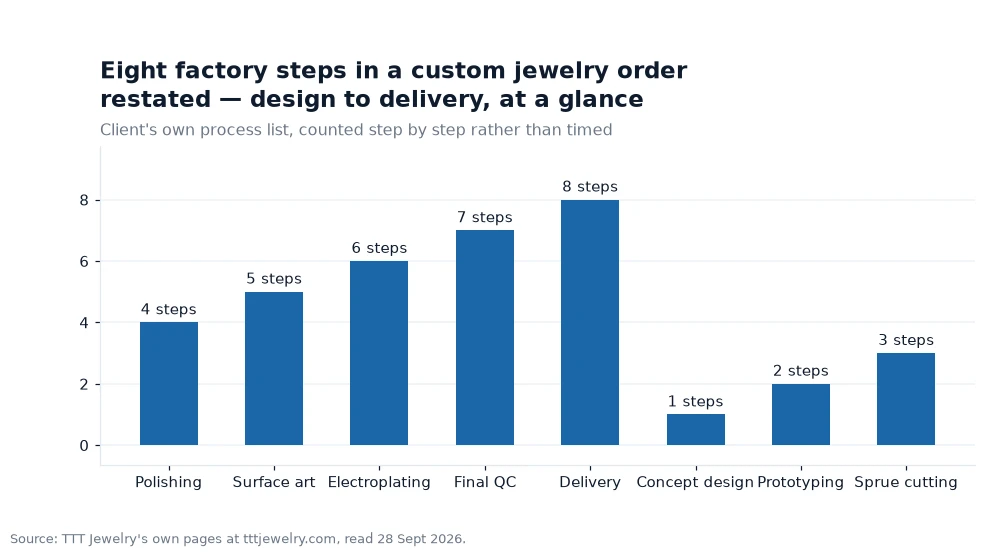
The published sequence is concept design by hand and CAD, then prototyping via a mould or 3D printing, sprue cutting, high-gloss polishing, surface art, brushed and textured, electroplating, final quality control, and delivery. Every private label order passes through all eight; the brand name on the piece changes none of them.
Numbering them is useful because it makes a schedule auditable. Step one is the only one measured in hours — under 48 hours of CAD work for a technical drawing and renderings. Steps two through five carry most of the sampling window, published at 25–35 days. Step six is plating, and steps seven and eight are inspection and dispatch. When a supplier reports progress, the step number is the honest unit of progress.
What private label actually changes
Two things move when an order becomes private label: the identity on the metal and the identity on the packaging. The metal side is handled by laser engraving, which applies a brand logo and a purity hallmark in one pass — the S925 hallmark, 18KGP on gold-plated work and 316L on stainless. The packaging side is one of the six customisation options and covers foil-stamped boxes, a metallic logo tag, barcode labelling, velvet or microfiber pouches and backing cards for display.
The rest is legal rather than physical. A 100% NDA covers the project, and the moulds, CAD files and the resulting collection stay exclusive: they are not resold and not shown to other buyers. For a private label brand this is the clause that makes the development spend worth making, because the tooling does not end up in a competitor's catalogue.
Step numbering also settles arguments about scope. A request for a matte finish on a steel pendant is a change to step five, surface art, and it may pull the piece back to step four as well. A request for a different pouch is step eight. Knowing which number a request belongs to tells you whether it costs days or a conversation, and it stops a small packaging change from being scheduled as though it were a fresh tooling run.
Where the risk sits in the sequence
| Step | Published duration or status | Private label impact |
|---|---|---|
| Concept design and 3D CAD | Under 48 hours | Logo and hallmark layout agreed here |
| Prototyping | Within the sampling window | Geometry proven before tooling |
| Sprue cutting and polishing | Within the sampling window | Surface the coating will sit on |
| Electroplating | Sixth of eight steps | Last changeable point for finish |
| Final QC and delivery | 100% inspected, then global shipping | Nothing ships unbranded or unchecked |
The risk concentrates at step six. Plating is the sixth of eight steps, so once a piece is plated there are exactly two operations left, and neither of them touches the surface. A private label brand that requests a colour change after the chamber has to accept a new sample run, which returns it to the front of the calendar.
Worked example: what the step numbering tells you about control
Treat each step as one eighth of the process. Plating is step six, so the operations that follow it are steps seven and eight: 2 ÷ 8 = 0.25, or 25% of the route. Everything that shapes the piece — design, prototyping, sprue cutting, polishing and surface art — is compressed into the first five steps, which is 5 ÷ 8 = 62.5% of the sequence.
The same reading applies to time rather than steps. Published durations cover three points: 48 hours of CAD, 25–35 days of sampling and 3–4 weeks of production. In days that is 2 + 25 to 35 + 21 to 28, so the planning block runs from 48 days at the fast end to 65 days at the slow end — roughly seven to nine weeks from approved drawing to shipped carton. A private label launch date that assumes less than that is assuming the sample comes back right the first time.
Private label adds one more field to the brief: the grade. 316L is published with 2–3% molybdenum, 100% waterproof performance, shower-safe and swim-proof, and medical-grade hypoallergenic status, and it is the grade that takes PVD best — the natural pick for a designer or waterproof line. 304 is water-resistant for ordinary daily wear, nickel and lead safe and reliably vacuum-plated, aimed at cost-effective high-volume and fast-fashion programmes. Naming the grade in the first message keeps the sample from being built twice.
What to send for a first private label order
The input list is deliberately open: sketches, reference photographs or a technical pack are all accepted, and none of them needs to be finished work. What does need to be stated is the base material, the finish, the hallmark, the logo, the packaging and the first-run quantity, because those six fields decide the tooling route and the minimum. The stainless steel MOQ is the published 100–150 pieces by style, which is the floor for a steel line.
Send them in one message. A brand that splits those decisions across four emails spends part of its 25–35 day sampling window waiting for its own answers, and the 24-hour response window on the factory side cannot shorten a question that has not been asked yet. The specification page at https://www.tttjewelry.com/stainless-steel-jewelry-manufacturer/ is the reference point for the steel route.
Frequently asked questions
Does the factory keep my design private?
Yes. A 100% NDA covers the project, and the moulds, CAD files and collection stay exclusive to your brand rather than being resold or shown to other customers.
How many pieces do I need for a private label steel piece?
100–150 pieces per style, quoted per design and per material, against 100 for artisan eco-brass and 50 per design for 925 sterling silver.
When can artwork for the logo and packaging be sent?
With the first enquiry. The logo and hallmark position is settled on the CAD drawing inside 48 hours, and the packaging choice is one of the six customisation options specified before final QC.
Planning the first private label production run
Write the six decision fields into the enquiry, name the step you are asking about when you chase, and keep the packaging in the same order as the jewelry. That covers the whole documented route without adding a stage to it. Two pages to read alongside this one: the inside-the-factory walkthrough for the eight steps in order, and the questions buyers ask most for the service terms, including the 24-hour response and the dedicated project manager.
The list this piece builds on — the 25–35 day custom sample window, the 100–150 piece stainless minimum (by style), followed by the shower-safe and swim-safe claim — is listed at the manufacturer's own website at the tttjewelry.com address, as of 28 Sept 2026. The chart's relative scale is mine rather than the manufacturer's[1].